|
|
 To complete the LAB's you need a copy of
the
To complete the LAB's you need a copy of
the
|
|
LAB 1 - Data in Registers |
|
|
Write the program as shown above - select Assemble from the main menu and
Note also the change to the program Counter (PC) contents... |

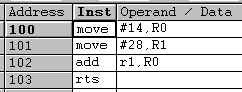

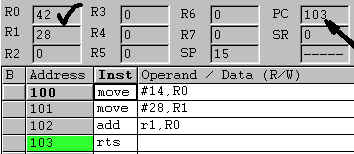
The Instruction Set
The processor executes a program which consists of a number of instructions.
The entire instruction set consists of some 400 instructions from which all
programs will be composed. The LAB 1 program above uses only three
instructions.
- a 'move' instruction
- an 'arithmetic' instruction
- the RTS instruction
|
|
LAB 2.1 |
|
|
Write a program to: make clear the number is in hex. with: move #$13, r1 note the register contents will still be displayed as decimal values so check the arithmetic by hand, or change the display ... |
Immediate Values
When a number used in an instruction has the
symbol # placed before it, e.g.
move #28, R2
28 is described as an 'immediate' value.
Subtract
Instructions
The instruction set will have similar instructions for subtract.
|
|
LAB 2.2 |
|
|
Write a program to store: Note, the notation (r0) to indicate 'the contents of r0'.
|